Create/disable/delete keys
SecretKey shown only once
Permission tree binds APIs and data
IP allowlist supports CIDR
Instant 403 after disable
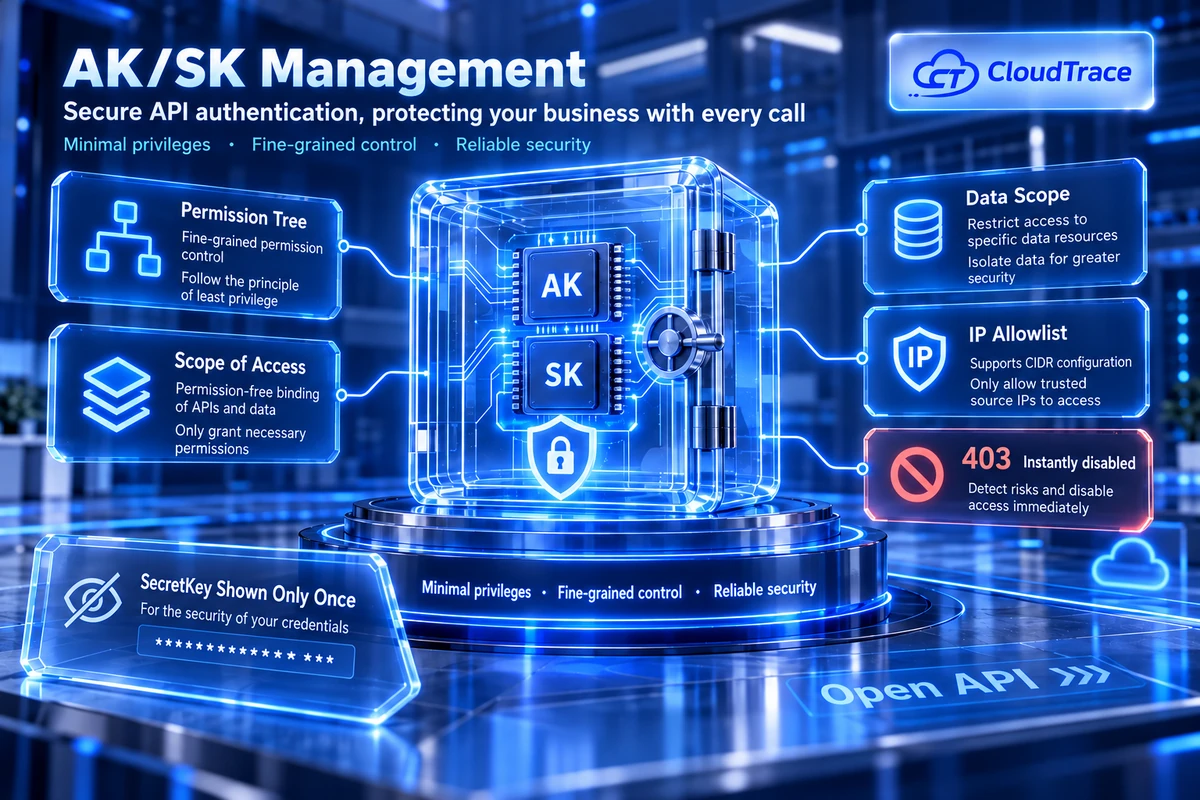
Click to enlarge


Expose DCloud, Hub and IoT capabilities as RESTful APIs and Webhooks to your business systems. One integration, full platform power.
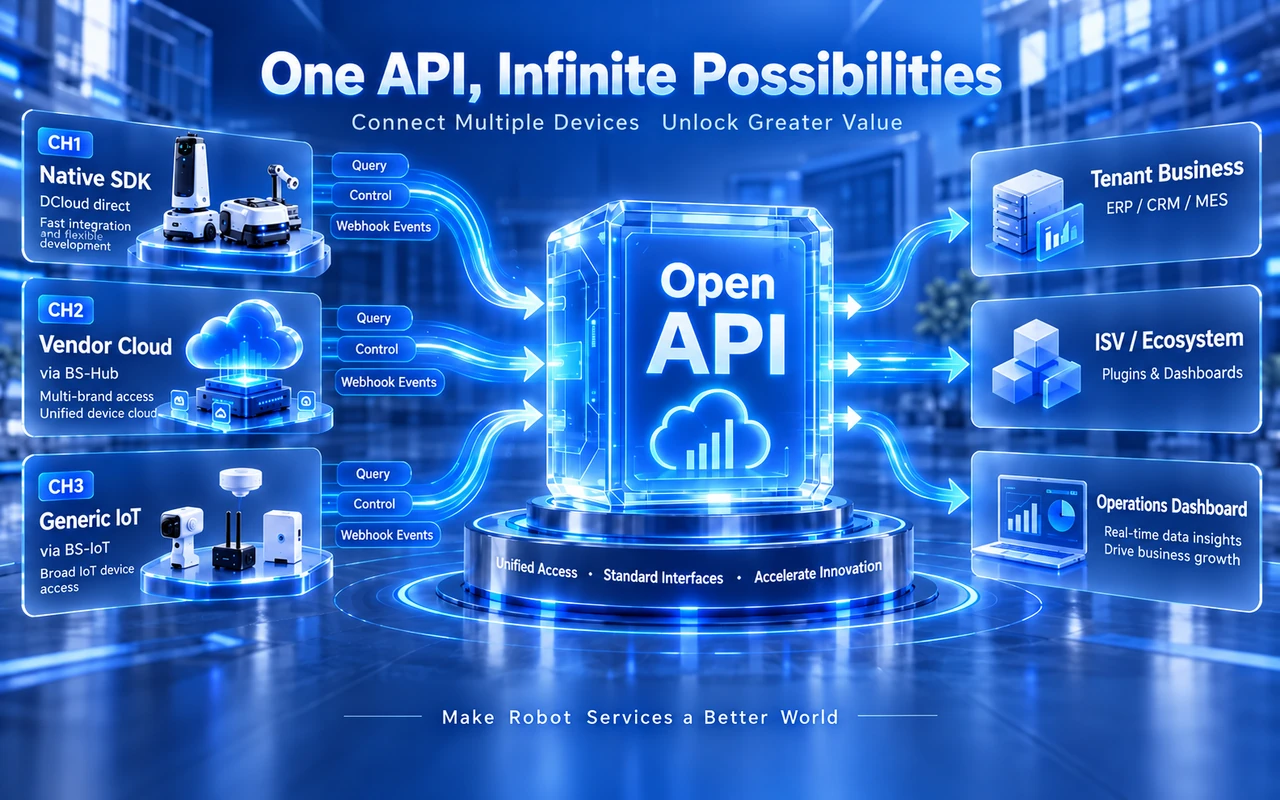
Open API is the unified exit for CloudTrace capabilities. CH1 native SDK devices, CH2 vendor-cloud devices via BS-Hub, and CH3 generic IoT devices via BS-IoT all share one RESTful API for query, command and event subscription.
BS-Hub onboards and translates vendor-cloud devices. Open API does not talk to vendor protocols directly.
BS-IoT connects generic IoT devices. Open API exposes IoT service calls through a unified interface.
Developers, IT admins, and ecosystem partners each find their answers here.
AK/SK signed auth, SecretKey shown only once, CIDR IP allowlist, per-tenant QPS throttling — minimize risk at the entry.
▎SK shown once · IP allowlist · QPS quota
HMAC-SHA256 signing with timestamp/nonce replay protection and exponential backoff retries for real-time event delivery.
▎≤5s delivery latency · Up to 5 retries · 5-min replay guard
Full records of time, AK, path, status, latency and IP with expandable details, sanitized params and CSV export.
▎Export 100k rows · Query ≤2s · Sanitized params
Volume trends, QPS peaks, error rates, API and AK rankings at a glance; click peaks to drill down to logs.
▎Real-time dashboard · API rankings · Peak-to-log drilldown
Official SDKs for Java, Python, Go, Node.js and C# with signing, request wrappers, error examples and historical versions.
▎5 languages · CDN ≤3s · Full examples
Categorized API catalog, request/response tables, changelog and Try-it-out debugging with red error highlighting.
▎Debug response ≤5s · Error highlight · Changelog
Hub brings devices in, IoT connects things, Open API exposes capabilities uniformly.
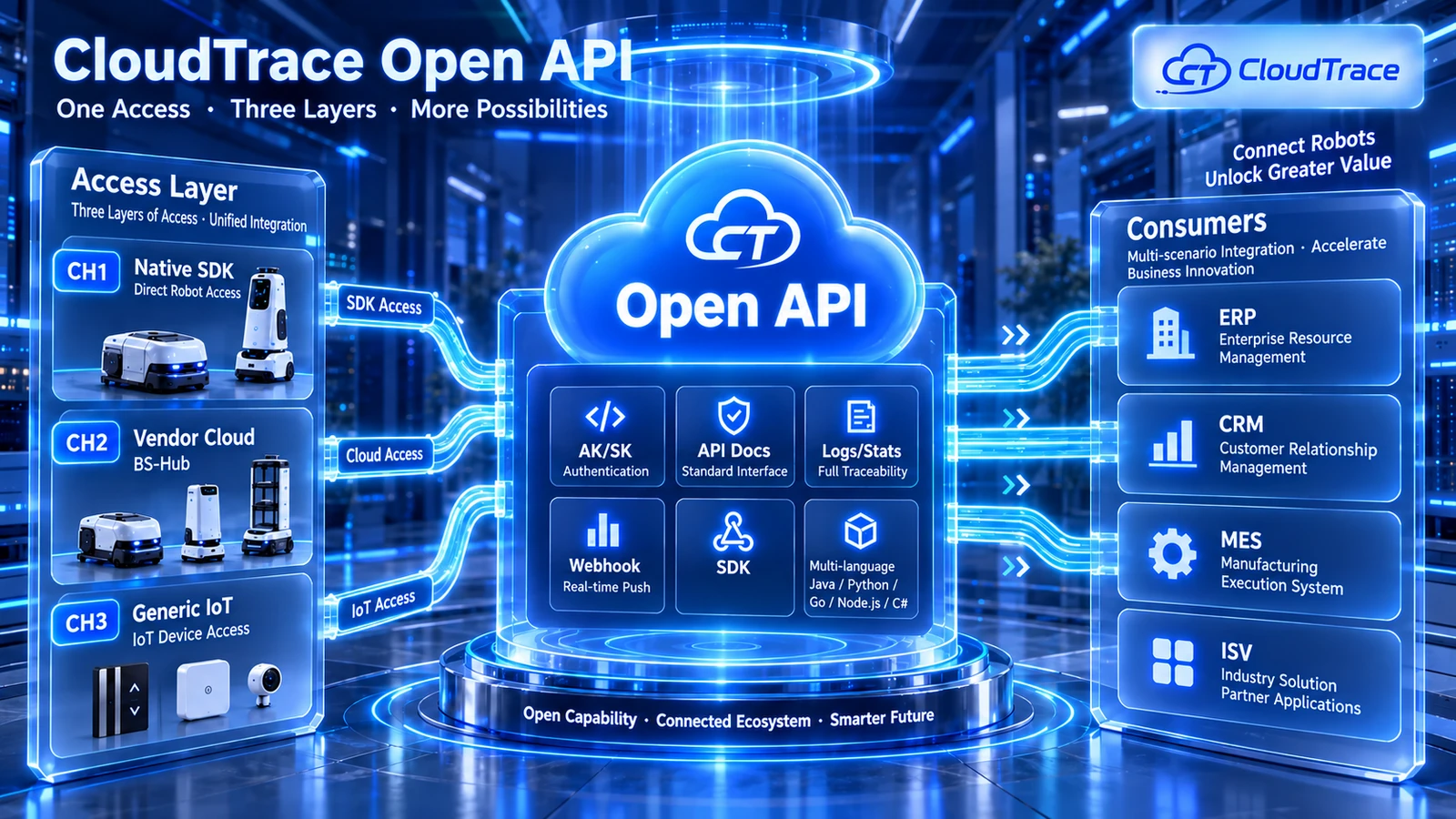
From credential management to SDK download, every step is designed for developers and admins.
Every key has clear permission boundaries from creation to disable. SecretKey is shown only once, with API/data-scoped authorization and CIDR allowlists.
Robot assets are scattered and ledgers don't match
Sync CH1/CH2 devices into ERP/CRM via unified query API
Completed tasks or alerts can't auto-create work orders
Subscribe to task/alert events to auto-generate work orders
Robots can't联动 with elevators, doors or sensors
Use IoT service calls to automate the production line
No standard data exit, high custom dev cost
Build dashboards using logs and stats APIs for end customers
| Dimension | Starter Read-only / PoC | ProfessionalMost Popular Multi-system / Production | Enterprise Enterprise / ISV Custom |
|---|---|---|---|
| Ideal for | Single-system read-only access, PoC, internal dashboards | Multi-system access with device control and event subscriptions | Large enterprises, ISVs, SLA and custom interfaces |
| Capabilities | Read-only APIs | Read/write + control + all Webhooks | All + early Beta access |
| Quota | Low (pilot level) | High (production level) | High + scalable |
| Key management | Basic permissions + IP allowlist | + grouping / expiry alerts / rotation | + dedicated audit / custom policies |
| Webhooks | 3 core event types | All 9+2 event types | Multiple callbacks / custom filters |
| Logs/Stats | 7-day logs + basic stats | 90-day logs + advanced filters + export | 180-day+ custom reports |
| SDK/Support | 5-language SDKs + docs | + online debugging + email support | + dedicated consultant + custom SDK |
| Deployment | SaaS | SaaS | SaaS / Private |
Read-only / PoC
Single-system read-only access, PoC, internal dashboards
Multi-system / Production
Multi-system access with device control and event subscriptions
Enterprise / ISV Custom
Large enterprises, ISVs, SLA and custom interfaces
Tell us your business systems and device types — we'll provide an integration plan and demo.
SK shown once · HMAC-SHA256 signing · sanitized logs · per-tenant QPS throttling
Some interface images above are system mockups, not actual screenshots. The actual system UI is as demonstrated by our sales team.