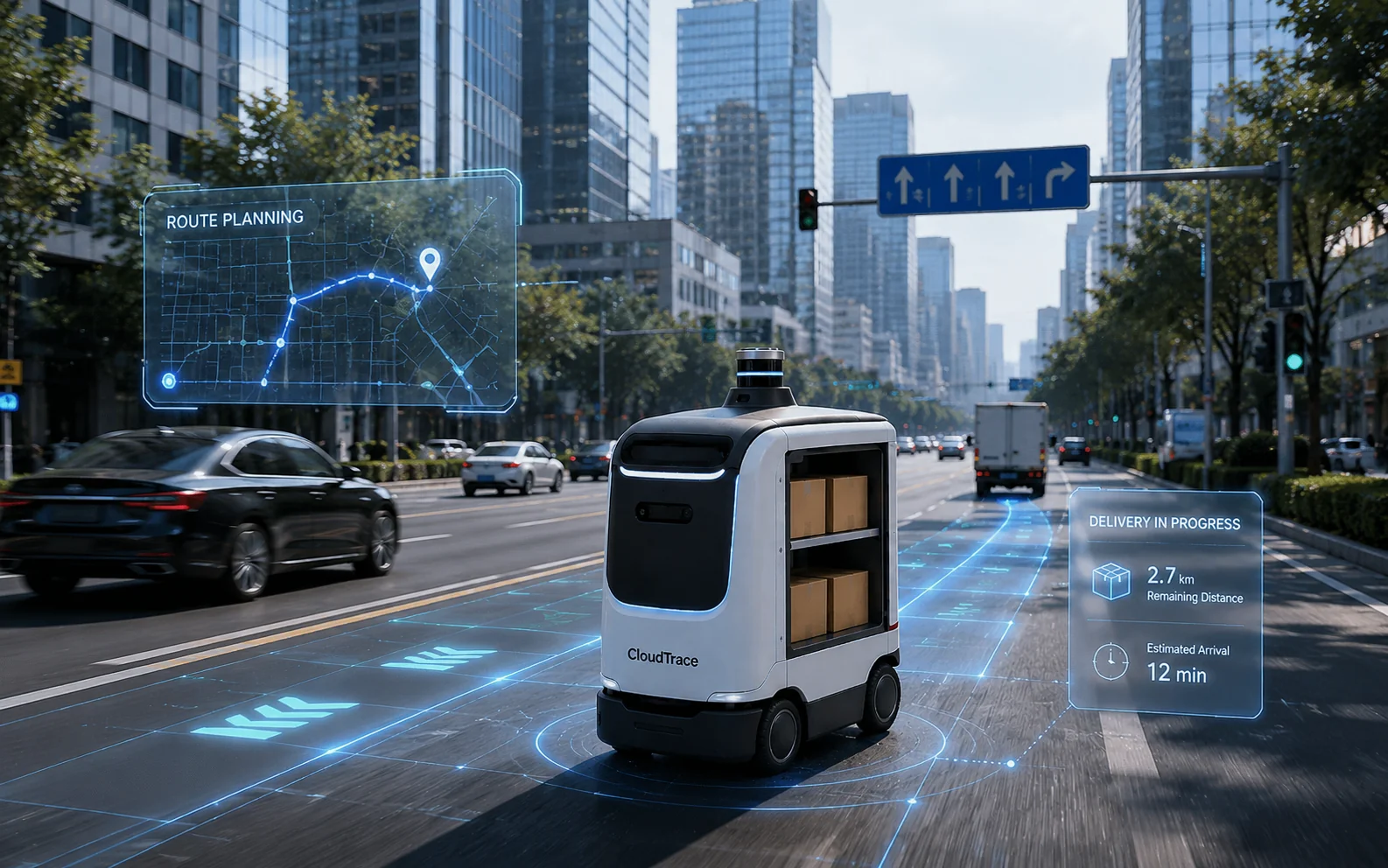
Delivery Robot Solution
Empower delivery robot commercialization with a full-link operations system
A one-stop cloud operations center integrating dispatching, warehousing, maintenance, analytics, and open integration to help hardware makers bring delivery robots into commercial deployment faster.
Make last-mile delivery in hotels, hospitals, office buildings and campuses more efficient and secure while significantly reducing labor costs.
Cloud dispatchingWarehouse & DeliveryMaintenance loopAnalyticsOpen integration
Pain Points
Differentiated customer needs, matched to full-scenario rollout
Covering hardware makers, scenario operators, channel service providers, and system integrators. Their core concern is not whether robots can move, but whether the solution can operate stably, deliver standardly, and replicate at scale.
Capability Loop
Four operational loops turn delivery from features into a scalable business
The capabilities are organized around task source, delivery execution, exception handling, and result feedback.
Workflow
Seven steps turn every delivery into traceable state
The workflow is now interactive so customers can see the action, output, and handoff of each step.
1
Create Task
Action
Requests from admin console, mini app, customer system, or OpenAPI enter the task pool.
Output
A trackable and assignable task order.
Action
Requests from admin console, mini app, customer system, or OpenAPI enter the task pool.
Output
A trackable and assignable task order.
Core Capabilities
Nine software modules support the full delivery robot operations loop
Translate device onboarding, mapping, dispatching, monitoring, permissions, maintenance, warehousing, OTA and analytics into deliverable business capabilities.
Business Outcome
Device profiles, remote status, tenant isolation and OTA binding turn mixed models into operable assets.
- Device profiles & per-device auth
- Remote status & diagnosis
- Multi-tenant isolation
- OTA policy binding
Device Onboarding
All packagesRegister and manage robots, chargers, compartments, and sensor status together
Best Fit
Register and manage robots, chargers, compartments, and sensor status together
Business Outcome
Device profiles, remote status, tenant isolation and OTA binding turn mixed models into operable assets.
- Device profiles & per-device auth
- Remote status & diagnosis
- Multi-tenant isolation
- OTA policy binding
Packages
Basic, Standard, and Advanced packages for different commercialization stages
From quick pilots to scaled operations and deep integrations, customers can grow by stage without over-building early.
Basic Package
Pilot Package
Prototype validation, single-site pilot, sales demo, and PoC teams
1-20 robots
- Device onboarding & cloud
- Basic task dispatch
- Single-site map
- Basic alerts & status
- SaaS fast launch
Why choose
Prove robots can onboard, dispatch, deliver, and review in the shortest time.
Not included / boundaries
No multi-tenant, OpenAPI, private deployment, source code or deep customization.
Recommended
Standard Package
Scaled Operations Package
Robot makers, property operators, hospitals, schools, and channel partners
20-300 robots
- Fleet dispatch & priority
- Multi-tenant roles
- Operations dashboard
- Maintenance tickets & remote diagnosis
- OpenAPI assessment
Why choose
Upgrade hardware delivery into an operable business system. The recommended commercial package.
Not included / boundaries
No private deployment, source cooperation or deep secondary development.
Advanced Package
Deep Integration Package
System integrators, key accounts, and hardware teams needing secondary development
300+ robots / multi-org
- Private deployment
- Full OpenAPI / Webhook
- Source-level co-build
- Sandbox testing
- Custom analytics
Why choose
Support deep customization, sandbox testing, and ecosystem integration for long-term partners.
Not included / boundaries
Deep system integration requires pre-sales interface assessment and scope confirmation.
Standard Package
RecommendedRobot makers, property operators, hospitals, schools, and channel partners
Scaled Operations Package
- Fleet dispatch & priority
- Multi-tenant roles
- Operations dashboard
- Maintenance tickets & remote diagnosis
Detailed capability comparison
Basic Package
Supported, with basic onboarding and status management
Standard Package
Supported, including fleet operations and multi-site management
Advanced Package
Supported, including multi-organization operations and deep integration
Capability
Basic Package
Standard Package
Advanced Package
Device onboarding and cloud management
Supported, with basic onboarding and status management
Supported, including fleet operations and multi-site management
Supported, including multi-organization operations and deep integration
Task dispatching and state machine
Basic
Enhanced
Advanced
Compartment / pickup code / verification
Supported, with basic compartments and pickup verification
Supported, including multi-compartment rules and exception handling
Supported, including custom compartment policies and system linkage
Multi-tenant roles and permissions
Not included
Supported, with multi-tenant and tiered role permissions
Supported, including multi-organization permissions and custom policies
Scenarios
One operations center adapts to different last-mile delivery contexts
Task sources, permissions, compartment rules, and integrations change by scenario, while the operations loop can be reused.
Delivery Path
SaaS Subscription, Private Deployment, Deep Customization
From standard SaaS to private deployment, CloudTrace provides a clear integration rhythm and open interfaces.
SaaS Subscription
Best for pilots and mid-sized projects, activated by customer, site, and device.
Private Deployment
Best for data security, intranet deployment, hospitals, schools, and large groups.
Deep Customization
Connect customer systems with OpenAPI, webhooks, sandbox testing and workflow customization.
Deliverables
- Scenario list
- Interface list
- Package recommendation
Focus
Lock the boundary before implementation starts.
Go-live Milestones
A dedicated delivery manager guides you through the entire go-live process and helps you launch successfully.
Week 1
Week 1Current 1/6
Plan Confirmation
Confirm delivery scenario, robot model, compartment capability, task source, third-party systems and acceptance goals.
Deliverables
- Scenario list
- Interface list
- Package recommendation
Focus
Lock the boundary before implementation starts.
Security & Compliance
Trusted delivery comes from compartments, permissions, audit, and exception closure
Security is now presented as clickable rule cards so customers can see how each risk is handled.
Compartment and Identity
Pickup codes, accounts, scans, or manual confirmation prevent wrong pickups and unrecorded handover.
Control 1
Compartment binding
Control 2
Open record
Control 3
Pickup verification
Tenant-level data isolationTraceable operation auditClosed exception handlingPrivate deployment optional
Pickup codes, accounts, scans, or manual confirmation prevent wrong pickups and unrecorded handover.
Control 1
Compartment binding
Control 2
Open record
Control 3
Pickup verification
Value Comparison
Customers buy an operational method, not just interface screens
Click each dimension in the comparison table to see how CloudTrace differs from typical project platforms.
Common Gap
Build a demo console
CloudTrace Value
Create a long-term robot delivery business system
Pre-sales selection and procurement
Common pre-sales questions
Verifiable answers covering fit, platform capabilities, integration, delivery, acceptance, and sourcing decisions.
DL-01Who is the CloudTrace delivery robot solution for?
It fits vendors and operators needing unified robot dispatch, delivery tasks, operational monitoring, maintenance, and site-system integration.
- Decision points
- Confirm target customers, fleet size, site count, branded experience, and operating ownership.
- Applicable when
- Business goals, robot capability, site conditions, and accountable owners can be confirmed and accepted in a pilot.
- Boundaries
- The platform does not replace delivery robot hardware, route or site permission, doors, elevators, or lockers, and does not guarantee untested third-party compatibility; price, schedule, capacity, SLA, and outcomes require assessment and agreement.
- CloudTrace capabilities
- DCloud, Map, Task, Monitor, Member, Maintain, OTA, open integration, and analytics, selected for the scenario and adapted to robot and business interfaces.
DL-03How can delivery depend less on manual dispatch and tracking?
Convert orders or service requests into robot tasks and view assignment, execution, exceptions, completion, and human handling together.
- Decision points
- Create a comparable baseline for current manual cost and the proposed digital workflow.
- Applicable when
- Business goals, robot capability, site conditions, and accountable owners can be confirmed and accepted in a pilot.
- Boundaries
- The platform does not replace delivery robot hardware, route or site permission, doors, elevators, or lockers, and does not guarantee untested third-party compatibility; price, schedule, capacity, SLA, and outcomes require assessment and agreement.
- CloudTrace capabilities
- DCloud, Map, Task, Monitor, Member, Maintain, OTA, open integration, and analytics, selected for the scenario and adapted to robot and business interfaces.
DL-05What core capabilities does a delivery robot operations platform need?
It normally needs device cloud, maps, dispatch, monitoring, permissions, maintenance and OTA, analytics, and site-ecosystem integrations.
- Decision points
- Separate launch-critical, optional enhancement, and later operations modules.
- Applicable when
- Business goals, robot capability, site conditions, and accountable owners can be confirmed and accepted in a pilot.
- Boundaries
- The platform does not replace delivery robot hardware, route or site permission, doors, elevators, or lockers, and does not guarantee untested third-party compatibility; price, schedule, capacity, SLA, and outcomes require assessment and agreement.
- CloudTrace capabilities
- DCloud, Map, Task, Monitor, Member, Maintain, OTA, open integration, and analytics, selected for the scenario and adapted to robot and business interfaces.
DL-07What inputs are required before delivery robot integration?
Prepare protocols, maps and positioning, task state machine, cargo functions, notifications, door/elevator/locker APIs, identity/payment needs, robots, and a site.
- Decision points
- Define protocols, data, environments, owners, and end-to-end test cases.
- Applicable when
- Business goals, robot capability, site conditions, and accountable owners can be confirmed and accepted in a pilot.
- Boundaries
- The platform does not replace delivery robot hardware, route or site permission, doors, elevators, or lockers, and does not guarantee untested third-party compatibility; price, schedule, capacity, SLA, and outcomes require assessment and agreement.
- CloudTrace capabilities
- DCloud, Map, Task, Monitor, Member, Maintain, OTA, open integration, and analytics, selected for the scenario and adapted to robot and business interfaces.
DL-09How should a delivery solution pilot and scale?
Choose one frequent, bounded delivery flow, validate tasks and critical site integrations, then expand robots, floors, sites, and business types.
- Decision points
- Pilot a representative scenario and expand only after passing agreed gates.
- Applicable when
- Business goals, robot capability, site conditions, and accountable owners can be confirmed and accepted in a pilot.
- Boundaries
- The platform does not replace delivery robot hardware, route or site permission, doors, elevators, or lockers, and does not guarantee untested third-party compatibility; price, schedule, capacity, SLA, and outcomes require assessment and agreement.
- CloudTrace capabilities
- DCloud, Map, Task, Monitor, Member, Maintain, OTA, open integration, and analytics, selected for the scenario and adapted to robot and business interfaces.
DL-11Is it better to build or buy a delivery platform?
If differentiation is the robot or delivery business, buying dispatch and operations foundations while retaining workflow and integration control merits evaluation.
- Decision points
- Compare three-to-five-year engineering, cloud, security, operations, and opportunity cost on equal scope.
- Applicable when
- Business goals, robot capability, site conditions, and accountable owners can be confirmed and accepted in a pilot.
- Boundaries
- The platform does not replace delivery robot hardware, route or site permission, doors, elevators, or lockers, and does not guarantee untested third-party compatibility; price, schedule, capacity, SLA, and outcomes require assessment and agreement.
- CloudTrace capabilities
- DCloud, Map, Task, Monitor, Member, Maintain, OTA, open integration, and analytics, selected for the scenario and adapted to robot and business interfaces.
Get Started
Move delivery robots from demo prototypes to repeatable commercial delivery
Tell us your robot model, target scenario, and current software stage. We will recommend the package, demo path, and implementation boundary.
50+ robot customers have chosen BigSight CloudTrace as their operations center partner
Some interface images above are system mockups, not actual screenshots. The actual system UI is as demonstrated by our sales team.